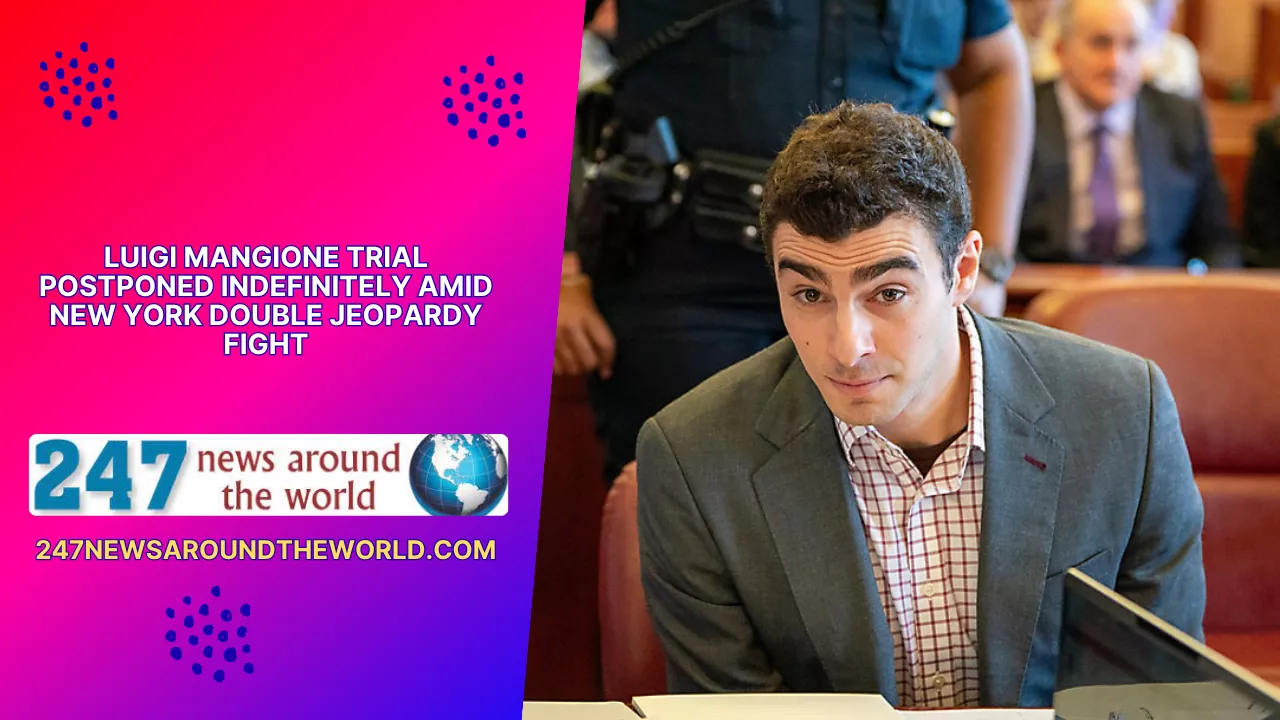
On Friday, August 14, 2026, Luigi Mangione stood in a Manhattan federal courtroom and said something he had spent 20 months declining to say.
“On the morning of Dec. 4, 2024, I shot Mr. Thompson in Manhattan, and he died.”
Brian Thompson’s wife, Paulette, sat in the front row. It was the first time members of the family had attended a court hearing in the case. She wiped away tears as prosecutors laid out the evidence.
Mangione, 28, entered what lawyers call an open plea: guilty to both federal stalking counts, with no plea agreement, no concessions, and nothing extracted from prosecutors in return. His attorneys told the court they had no valid defense.
Within minutes of the plea, his legal team filed a motion that turned the case in a new direction. They asked a state judge to throw out the New York murder prosecution entirely, arguing that trying him again would violate double jeopardy protections.
On Monday, August 17, Judge Gregory Carro cancelled the state trial that was due to begin on September 8. He gave Manhattan prosecutors until October 9 to respond and scheduled a hearing for December 10, eight days before Mangione is sentenced in the federal case.
The state trial is now postponed indefinitely. Whether it ever happens depends on a question of New York statutory law that most Americans have never encountered.

What the Judge Actually Ordered
Precision matters here, because coverage has described the ruling in several different ways.
Judge Carro’s order did not formally adjourn the trial. What it did was set a briefing schedule that makes a September 8 start impossible. Prosecutors have until October 9 to file their response to the defense motion. The next hearing is December 10. Jury selection cannot proceed while the motion is pending.
The practical effect is an indefinite postponement. The legal mechanism is a deadline.
That distinction matters for anyone tracking the case, because it means Carro has not yet ruled on the substance of the double jeopardy claim. He has only cleared time to consider it.
The December 10 hearing date is itself informative. It falls eight days before Luigi Mangione federal sentencing on December 18. Carro appears to want the federal sentence in view, or nearly in view, before deciding whether New York’s prosecution can go forward.
Luigi Mangione’s New York state trial has been delayed until December after his defense team filed a motion to dismiss the case on double jeopardy grounds.
The motion follows Mangione’s guilty plea last week to federal charges in the killing of UnitedHealthcare CEO Brian… pic.twitter.com/lGlonr2Inb
— CBS Mornings (@CBSMornings) August 18, 2026
Why This Is Not the Double Jeopardy You Learned About
Most people encounter double jeopardy through the Fifth Amendment, which bars a person from being tried twice for the same offense.
Under longstanding federal doctrine, that protection does not stop a state and the federal government from both prosecuting the same conduct. The two are treated as separate sovereigns, each with its own authority to enforce its own laws. The U.S. Supreme Court reaffirmed this in 2019.
If the Fifth Amendment were the whole story, Mangione’s motion would fail quickly.
It is not the whole story. New York has its own statutory double jeopardy protections, and they are considerably broader than the federal constitutional floor.
The New York Rule
Under New York law, a state prosecution can be barred when a prior federal case involving the same course of conduct or the same criminal transaction has already ended in a guilty plea or reached the point where a jury was sworn.
Two elements of that are worth pulling apart.
First, the trigger is a criminal transaction, not an identical offense. That is a wider net than the federal test, which asks whether each offense requires proof of a fact the other does not.
Second, a guilty plea counts. Mangione did not need a verdict. By pleading guilty on August 14, he satisfied the statutory trigger himself.
Legal observers have noted that New York’s protections against successive prosecutions are unusually strong compared with federal law and with most other states. That is the pillar the defense motion rests on.
The Exception Prosecutors Are Invoking
New York’s statute contains carve-outs. The most relevant one applies where the offenses have substantially different elements and are directed at substantially different kinds of harm.
Loyola Law School professor Jessica Levinson described the shape of the argument to CBS News. The defense position is that the federal stalking charges and the state murder charges rest on the same conduct and the same facts. The prosecution position is that a carve-out applies, and that the elements of federal stalking and state murder are substantially different.
That is the entire fight, compressed into two sentences.
The Competing Arguments
Both sides have filed their positions. Here is what each is actually claiming.
The Defense
Mangione’s lawyers argue the two prosecutions cover identical ground. In their filing, they wrote that the full range of conduct making up the stalking offense is coterminous with the conduct committed as part of the murder offense. They added that his travelling from out of state to reach the crime scene does nothing to separate the stalking of Thompson from the acts constituting his murder, because they are all part of the same criminal incident or criminal transaction.
They have also framed the case in institutional terms, describing Mangione as a pawn in parallel prosecutions and accusing state and federal prosecutors of trying to punish him twice for the exact same conduct.
Lead defense attorney Karen Friedman Agnifilo put it to reporters after the plea: “He’s been treated differently from every other defendant charged with this offense in New York, however thankfully New York law does not allow this.”
The Prosecution
Manhattan District Attorney Alvin Bragg’s office contends the state charges, which include murder and firearms offences, involve different legal elements and different criminal conduct.
The office has also raised a timing argument. In a letter last month, Assistant District Attorney Joel Seidemann objected to the prospect of a federal guilty plea wiping out the state case, writing that any guilty plea must account for the seriousness of the defendant’s offences.
A spokeswoman for the office said after the plea that it would fight the dismissal effort, noting the office had been preparing since December 2024 to pursue a conviction in New York State Supreme Court and was prepared to litigate the defence motions while federal sentencing remained pending.
That last clause is the key to the office’s strategy.
Read More: Meet Hayden Panettiere Parents and Siblings with Details of Her Cause of Death
The Strategic Logic Behind the Dates
Neither side is purely arguing law here. Both are watching December 18.
A source familiar with the DA office’s discussions told NBC News the office intended to fight the double jeopardy motion until it sees the outcome of federal sentencing. Prosecutors have said they will seek a life term.
The reasoning is straightforward. If Mangione receives life in prison federally, a second trial in state court delivers little additional punishment while consuming enormous resources and carrying real risk of an adverse ruling. If he receives something closer to the guideline range, the calculation changes.
Federal prosecutors told the court the sentencing guidelines suggest roughly 24 to 30 years. Judge Margaret Garnett is not bound by that range and can impose up to life. Mangione was also told he would serve at least 85 percent of whatever term is imposed.
CNN has reported that if the DA’s office is satisfied with the federal sentence, it could agree to dismiss the state charges. New York legal experts have suggested state prosecutors are unlikely to see a trial now that the federal case is resolved.
Carro’s December 10 hearing date, sitting eight days before sentencing, gives every party a chance to see how close that outcome is before the state case is decided one way or the other.
Why Plead Guilty With No Deal?
Mangione received nothing from federal prosecutors in exchange for his plea. No reduced charges, no sentencing recommendation, no agreement of any kind. His lawyers have not explained the timing publicly.
Two practical theories have circulated among legal commentators. Attorney Rich Schoenstein told CBS New York that pleading guilty can be an inroad to a lighter sentence from the judge, and separately noted speculation that Mangione may prefer federal custody to a New York state prison, which would require a federal conviction.

The third and most direct explanation is the one visible in the docket. The plea triggered New York’s statutory double jeopardy protection, which requires a completed prior prosecution. Nothing else Mangione could have done would have produced that trigger before September 8.
Timeline of the Case
| Date | Event |
|---|---|
| Dec. 4, 2024 | Brian Thompson, 50, shot outside a Midtown Manhattan hotel while walking to an investor conference |
| Dec. 9, 2024 | Mangione arrested at a McDonald’s in Altoona, Pennsylvania, after a five-day manhunt |
| Dec. 17, 2024 | Manhattan DA announces state indictment |
| April 2025 | Attorney General Pam Bondi directs federal prosecutors to seek the death penalty |
| April 25, 2025 | Mangione pleads not guilty to federal charges |
| Sept. 2025 | State first-degree murder and terrorism charges dismissed |
| Jan. 30, 2026 | Judge Garnett blocks the death penalty and dismisses two federal counts; evidence from the arrest ruled admissible |
| Feb. 6, 2026 | Mangione tells reporters while leaving court: “It’s the same trial twice” |
| April 1, 2026 | Judge Garnett refuses to delay the federal trial |
| Aug. 11, 2026 | Pre-trial hearing in state court on the September trial |
| Aug. 14, 2026 | Mangione pleads guilty to two federal stalking counts; defence files double jeopardy motion the same day |
| Aug. 17, 2026 | Judge Carro cancels the Sept. 8 trial, sets an Oct. 9 response deadline and a Dec. 10 hearing |
| Oct. 9, 2026 | Prosecution response due |
| Dec. 10, 2026 | State court hearing on the double jeopardy motion |
| Dec. 18, 2026 | Federal sentencing before Judge Garnett |
What Mangione Admitted in Federal Court
The allocution produced details that had not previously been public.
Mangione told the court he posed as a potential investor managing more than $50 billion in assets and emailed UnitedHealth leadership to confirm the location of the 2024 investor conference so he could establish Thompson’s whereabouts. He said he manufactured a firearm using a 3D printer and travelled to New York.
According to the Justice Department, he approached Thompson from behind at approximately 6:45 a.m. on December 4, 2024, shot him multiple times, and fled. Thompson was 50 and a father of two.
“I knew what I was doing was illegal,” Mangione told Judge Garnett.
He said he was motivated by his experience with the healthcare system.
U.S. Attorney Jamie McDonald addressed that framing directly: “Violence is not a legitimate instrument to promote any political or social message.”
Thompson’s family issued a rare public statement, calling the plea an important step toward justice and saying that while nothing would ease the pain of losing him, they were grateful the federal justice system had held the person responsible accountable. They asked the court to ensure sentencing reflects the severity of the crime, and noted that proceedings in New York and Pennsylvania remain outstanding.
The Three Prosecutions, Compared
Mangione faces charges in three jurisdictions. They are frequently conflated in coverage.
| Federal (SDNY) | New York State | Pennsylvania | |
|---|---|---|---|
| Status | Resolved by guilty plea, Aug. 14, 2026 | Postponed indefinitely | Pending |
| Charges | Two counts of stalking resulting in death | Second-degree murder, weapons and forgery counts | Firearms and false identification offences tied to his arrest |
| Maximum penalty | Life imprisonment | Life imprisonment | Substantially lower |
| Relates to Thompson’s death | Yes | Yes | No, arises from the Altoona arrest |
| Next date | Sentencing, Dec. 18, 2026 | Hearing, Dec. 10, 2026 | Not scheduled |
The Pennsylvania case is unaffected by the double jeopardy dispute because it concerns different conduct: what officers found when they arrested him, rather than the killing itself.
Why This Case Matters Beyond Its Facts
Parallel state and federal prosecutions are common in the United States. What is uncommon is watching one dismantle the other in public, on a compressed timeline, in a case this closely followed.
Three elements make this instructive.
Federalism has practical consequences. The dual sovereignty doctrine permits duplicate prosecutions as a matter of constitutional law. New York has chosen by statute to give defendants more protection than the Constitution requires. Most people assume double jeopardy is a single national rule. It is not, and the difference is deciding a homicide case.
Charging decisions carry downstream risk. Federal prosecutors charged stalking resulting in death, in part because a murder count was dismissed in January 2026 along with the death penalty. Stalking is a conduct-based offence that necessarily encompasses the surveillance, travel, and approach preceding the shooting. That breadth is precisely what the defence is now using to argue the two cases cover the same transaction.
Sequence can determine outcome. Both offices spent 2025 and early 2026 fighting over which trial would go first. Judge Carro set the state trial for June 8, then September 8. Federal prosecutors resisted delay. That procedural manoeuvring, which looked like scheduling at the time, may prove to have been the decisive contest in the case.
Frequently Asked Questions
Why was Luigi Mangione’s trial postponed?
Judge Gregory Carro cancelled the September 8 state trial after Mangione’s lawyers filed a motion to dismiss the New York case on double jeopardy grounds, following his August 14 federal guilty plea. Prosecutors must respond by October 9, with a hearing set for December 10.
Did Luigi Mangione plead guilty?
Yes, in the federal case. On August 14, 2026, he pleaded guilty to two counts of stalking resulting in death and told the court he shot Brian Thompson. He has pleaded not guilty in the New York state case, which remains pending.
Did he get a plea deal?
No. He entered an open plea to all pending federal counts with no agreement, concessions, or benefits from prosecutors. Both sides confirmed this in court.
Can he be tried twice for the same killing?
Under the federal Constitution, generally yes, because state and federal governments are treated as separate sovereigns. Under New York’s own statute, which is broader, a state prosecution can be barred where a prior federal case involving the same criminal transaction ended in a guilty plea. Whether an exception applies is the question now before Judge Carro.
What sentence does he face?
Federally, up to life imprisonment. Prosecutors said federal guidelines suggest roughly 24 to 30 years, but Judge Margaret Garnett is not bound by that and prosecutors are seeking life. Sentencing is December 18, 2026. The state charges also carry a possible life sentence.
Will the state case be dropped?
Undecided. The DA’s office says it will continue litigating and is waiting to see the federal sentence. CNN has reported that if the office is satisfied with that sentence, it could agree to dismiss. New York legal experts have suggested a state trial now looks unlikely.
What happened to the death penalty?
Judge Garnett blocked it on January 30, 2026, dismissing two federal counts including murder. The remaining stalking counts carry a maximum of life imprisonment. New York state has no death penalty.
What about the Pennsylvania charges?
Those relate to firearms and false identification offences arising from his December 2024 arrest in Altoona, not to Thompson’s death. They are unaffected by the double jeopardy dispute.
When will we know whether the state trial happens?
The next milestone is the October 9 prosecution filing, followed by the December 10 hearing. Either side could appeal Carro’s eventual ruling, which would add further delay.
Read More: Jeremy Clarkson and Tyson Fury Top NTA Documentary Nominees
Last Updated on August 18, 2026 by 247 News Around The World