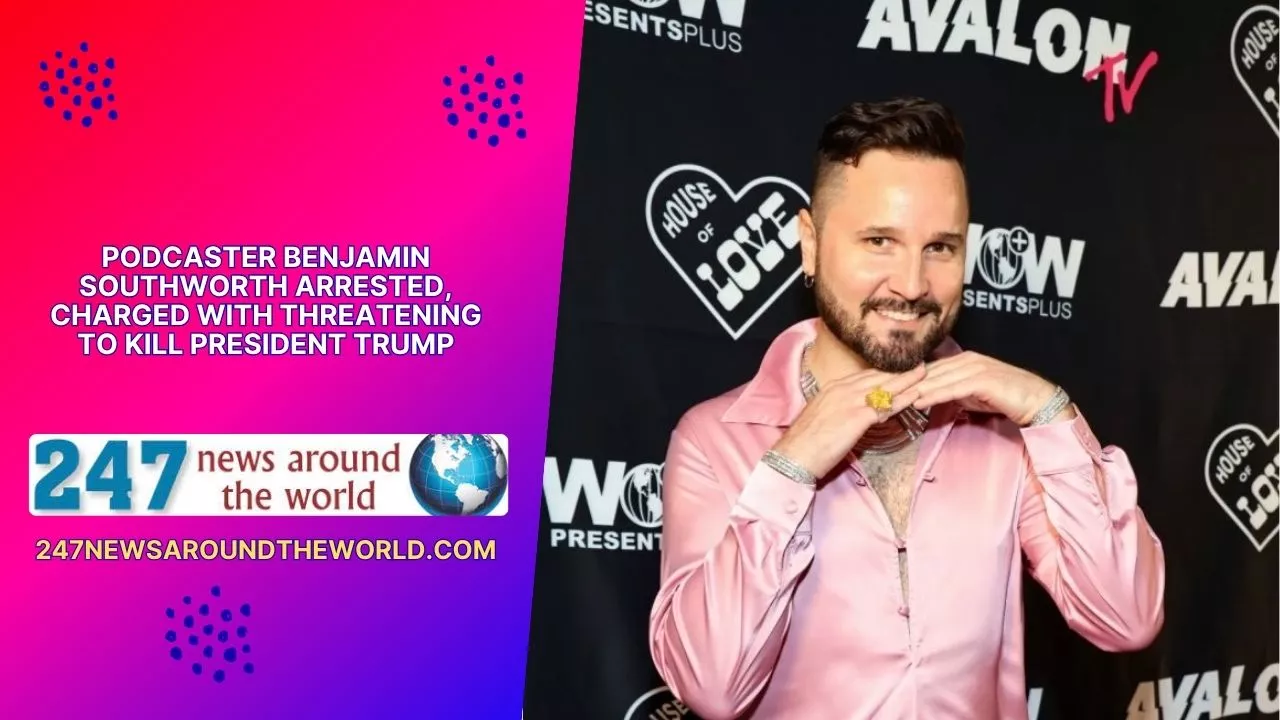
Podcaster and former Christian television personality Benjamin Azariah Southworth was arrested by federal agents on September 3, 2026, at his apartment in the Westlake neighborhood of Los Angeles. A federal grand jury had returned a three-count indictment one day earlier charging the 40-year-old with threatening to kill President Donald Trump, cyberstalking, and making harassing telephone calls in interstate communications.
First Assistant U.S. Attorney for the Central District of California Bill Essayli confirmed the arrest and posted a photograph of Southworth being taken into custody. According to multiple outlets, Southworth surrendered without incident but shouted statements about the president during the arrest. He was arraigned the same afternoon at U.S. District Court in downtown Los Angeles, where he entered a not guilty plea and was held without bond. His next court appearance is scheduled for October 2026.
The case centers on social media posts prosecutors say Southworth made between January and May 2026 across YouTube, Instagram, and TikTok, as well as an alleged months-long harassment campaign targeting a former personal attorney of President Trump and that attorney’s family.

Who Is Benjamin Azariah Southworth
Benjamin Azariah Southworth, born May 13, 1986, grew up in Orland, Indiana. He attended Indiana-Purdue University of Fort Wayne and the University of Nevada, Las Vegas.
In the late 2000s, Southworth became known for hosting “The Remix,” a syndicated reality and music television program that aired on several Christian broadcast networks, including the National Religious Broadcasters (NRB) network, Trinity Broadcasting Network (TBN), JCTV, and VTN. The show featured performances and appearances by Christian artists such as Jars of Clay, Rachael Lampa, and Shane & Shane, and reportedly attracted more than 200,000 weekly viewers at its peak.
On April 16, 2008, Southworth publicly came out as gay, a decision he acknowledged at the time would likely end his career in Christian broadcasting. Coverage of the announcement appeared in outlets including The Huffington Post. He later served as an opening act for gay Christian singer Ray Boltz during a national tour in 2010.
In 2020, Southworth co-launched a podcast called “Yass, Jesus!” alongside actor Daniel Franzese, known for his role in the 2004 film “Mean Girls.” The show described itself as an interfaith, sexuality-affirming comedy podcast built on the idea that faith and LGBTQ identity do not have to be in conflict. Southworth also used the professional name Azariah Southworth and was nominated for a GLAAD Award for his advocacy work. His personal website described him as an activist based in Los Angeles who uses his platform to challenge what he calls Christian nationalism and anti-LGBTQ bigotry.
Benjamin Azariah Southworth, 40, of Los Angeles has been indicted by a grand jury on federal charges for threatening to kill President Trump, cyberstalking, and making harassing interstate calls.
Southworth is charged with posting videos calling for President Trump’s… pic.twitter.com/HSoVmWx36c
— F.A. United States Attorney Bill Essayli (@USAttyEssayli) September 3, 2026
The Federal Charges Against Southworth Explained
Southworth faces three federal counts:
Count 1: Threats Against the President (18 U.S.C. Section 871) This statute makes it a federal felony to knowingly and willfully make a threat to take the life of, kidnap, or inflict bodily harm upon the President of the United States. A conviction carries a maximum sentence of five years in federal prison and a fine of up to $250,000. The government does not need to prove the defendant intended to carry out the threat, only that the statement was made knowingly and willfully and that a reasonable person would interpret it as a serious expression of intent to harm.
Count 2: Cyberstalking (18 U.S.C. Section 2261A) This charge relates to conduct that allegedly used electronic communications to harass or intimidate another person, causing substantial emotional distress or fear of harm. Conviction on this count carries a maximum sentence of five years.
Count 3: Harassing Telephone Calls in Interstate Communications (47 U.S.C. Section 223) This charge applies to the use of telephone and electronic communications to harass or threaten individuals across state lines. It carries a maximum penalty of two years in federal prison.
Combined, Southworth faces up to 12 years in federal prison if convicted on all counts.
What Prosecutors Say Southworth Did: A Timeline of the Alleged Threats
According to the federal indictment and court filings cited across multiple news outlets, Southworth’s alleged conduct spanned from January 2026 to May 2026. Prosecutors allege he used YouTube, Instagram, TikTok, and a personal website to post threatening content directed at President Trump and to harass a former Trump personal attorney and the attorney’s family.
January 2026: The Harassment Campaign Allegedly Begins
Prosecutors allege that Southworth posted the home address of a former personal attorney of President Trump on his TikTok account. The post allegedly included a photograph of the attorney, a photograph of the attorney’s home, and the words “No peace for traitors.” The attorney was not named in the indictment. FBI Director Kash Patel later publicly identified the victim as Jay Sekulow, a longtime Trump legal adviser who served on the president’s defense team during his first impeachment trial and throughout the Mueller investigation.
Over the weeks that followed, Southworth is alleged to have harassed Sekulow’s son and wife through a combination of online messages, voicemails, and telephone calls. Prosecutors claim he placed at least 13 phone calls that included insults and statements such as “justice comes to your door.” He also allegedly published family phone numbers on Instagram alongside what prosecutors described as a mocking Valentine’s Day-themed message.
March 31, 2026: A Video Post About the Supreme Court
Federal prosecutors allege that on or around March 31, 2026, Southworth posted a public video on his Instagram account using the handle @theholymenace, referencing a Supreme Court ruling. The specific content of that post is described in court filings as part of the broader pattern of threats.
April 7, 2026: The Most Direct Alleged Threat
The indictment identifies April 7, 2026, as the date of the most explicit alleged threat. Prosecutors say Southworth posted a video on Instagram containing a series of statements directed at the president. According to court documents cited by NBC News, ABC7 Los Angeles, CBS News, and the Department of Justice, the video allegedly included language referencing the execution of the president and a call to act.
Separately, prosecutors describe another video in which Southworth allegedly depicted himself “fictitiously teleporting into the White House Oval Office, behind President Trump, and raising a knife up to President Trump’s head as if he was about to stab him.” The filing notes that a woman’s scream is heard before the video ends, followed by a listing for Southworth’s website.
January to May 2026: Merchandise Sales
Court documents and news reports also reference Southworth’s personal website, where he allegedly sold merchandise connected to his political statements. Prosecutors cite these materials as part of the pattern of conduct described in the indictment.
Also Read: Bunnie Xo’s Jelly Roll Split Took Serious Toll On Her Body
The Legal Standard for Threatening the President
Threatening the life of the president has been a federal crime for more than a century. The current statute, 18 U.S.C. Section 871, applies to anyone who knowingly and willfully makes such a threat, whether through mail, social media, public speech, or any other means of communication.
The legal question in these cases often turns on what constitutes a “true threat” as opposed to protected political speech. The Supreme Court addressed this issue in Elonis v. United States (2015), ruling that the government must prove more than that a reasonable person would interpret a statement as threatening. The defendant’s subjective intent matters as well. Courts continue to apply this standard in social media-era cases, where the line between political rhetoric and a genuine threat can be harder to define.
In practice, the U.S. Secret Service investigates all credible threats against the president and distinguishes between direct statements of intent to harm and indirect expressions of frustration or anger. Not every hostile social media post results in prosecution, but those that cross the threshold of a true threat, combined with additional conduct such as doxxing or harassment, often lead to indictment.
The Broader Pattern of Threat Prosecutions in 2025 and 2026
Southworth’s arrest is part of what federal officials describe as a broader enforcement effort against threats to the president’s life. Attorney General Todd Blanche said in a statement that the Department of Justice will respond to escalating threats “with the full force of the law.”
Several other individuals have faced similar charges in recent years. In April 2026, a federal grand jury in North Carolina indicted former FBI Director James Comey on charges under the same statute after he posted an image on Instagram that prosecutors alleged was a coded threat. Comey’s case remains pending.
In February 2026, a Portland man was arrested on federal charges related to online threats against the president and supporters of U.S. Immigration and Customs Enforcement.
The pattern reflects a growing focus by federal prosecutors on social media conduct that crosses the line from political commentary into what the law defines as true threats.
How Social Media Threats Become Federal Cases
The process by which an online post becomes a federal prosecution involves multiple agencies and several legal steps.
Detection and Reporting
The U.S. Secret Service monitors social media for threats against the president and other protectees. Tips also come from private citizens, social media platforms, and other law enforcement agencies.
Investigation
Once a potential threat is identified, the Secret Service and the FBI evaluate the credibility and seriousness of the statement. They examine the full context of the post, the poster’s history, any pattern of escalating behavior, and whether the person has taken any steps toward carrying out the threat. In Southworth’s case, investigators reportedly reviewed social media posts spanning five months.
Grand Jury and Indictment
If investigators and prosecutors determine the evidence supports a charge, the case goes to a federal grand jury, which reviews the evidence and decides whether to return an indictment. In Southworth’s case, the grand jury returned its indictment on September 2, one day before his arrest.
Arrest and Arraignment
Federal agents execute the arrest. The defendant is brought before a federal magistrate or district judge for arraignment, where they enter a plea and the court decides whether to set bail or hold the defendant without bond. Southworth was held without bond.
What Comes Next in the Southworth Case
Southworth is scheduled to return to federal court in October 2026. Because he has pleaded not guilty, the case could proceed to a trial unless a plea agreement is reached beforehand.
Key factors that may shape the case going forward include the volume and specificity of the social media evidence, whether prosecutors can establish the subjective-intent standard required under the true threat doctrine, and whether defense attorneys argue that Southworth’s statements were protected political expression rather than genuine threats.
The cyberstalking and harassment charges add complexity. Even if a defense team contests the presidential-threat charge on First Amendment grounds, the allegations of doxxing, phone harassment, and intimidation of a private citizen’s family members operate under a separate legal framework that is generally harder to defend on free speech grounds.
Frequently Asked Questions
Who is Benjamin Azariah Southworth?
Southworth is a 40-year-old former Christian television host and podcaster from Indiana who was living in Los Angeles at the time of his arrest. He hosted “The Remix” on Christian networks and later co-hosted the podcast “Yass, Jesus!” with actor Daniel Franzese.
What are the charges against Benjamin Southworth?
He is charged with three federal counts: threatening to kill the president (under 18 U.S.C. Section 871), cyberstalking (under 18 U.S.C. Section 2261A), and making harassing telephone calls in interstate communications (under 47 U.S.C. Section 223).
What is the maximum sentence Southworth faces?
If convicted on all three counts, he faces a combined statutory maximum of 12 years in federal prison: five years for the presidential-threat charge, five years for cyberstalking, and two years for the telephonic harassment charge.
How did Southworth plead?
He pleaded not guilty at his arraignment on September 3, 2026. He is being held without bond.
Who was the attorney allegedly targeted in the harassment campaign?
The indictment did not name the attorney. FBI Director Kash Patel later publicly identified the victim as Jay Sekulow, a longtime personal lawyer for President Trump.
Is threatening the president protected by free speech?
No. The Supreme Court has held that “true threats” are not protected by the First Amendment. A true threat is a statement that a reasonable person would interpret as a serious expression of intent to commit violence, as distinguished from idle talk, jokes, or political hyperbole. However, the line between protected speech and a prosecutable threat is determined case by case, and the defendant’s subjective mental state is relevant.
Also Read: TLC’s T-Boz Hospitalized After Sickle Cell Crisis, Misses Several Tour Dates
Last Updated on September 4, 2026 by 247 News Around The World