
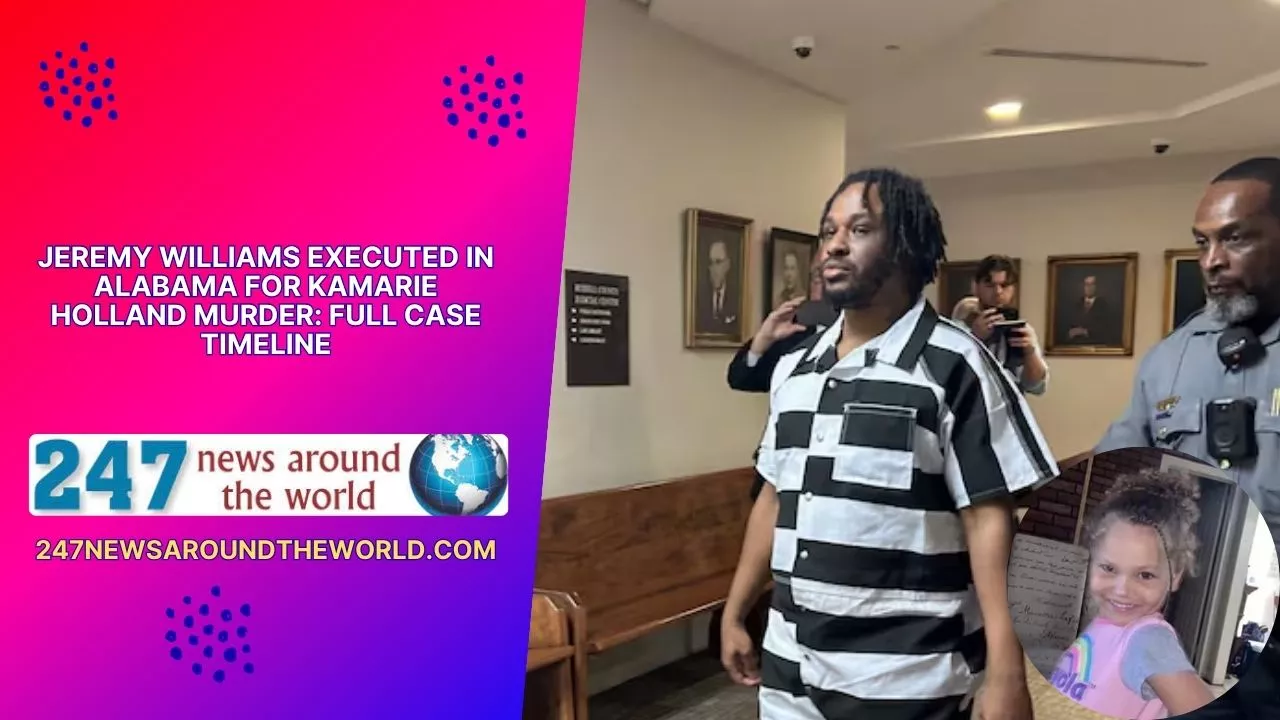

On the evening of Thursday, August 13, 2026, the state of Alabama carried out the execution of Jeremy Tremaine Williams by lethal injection at the William C. Holman Correctional Facility in Atmore. He was 42 years old, and he was pronounced dead at 6:16 p.m. Central Time.
Williams was the first person executed by Alabama in 2026, and part of a rare confluence in which three US states executed inmates on the same day by lethal injection, the first such occurrence since 2010.
His conviction stemmed from what prosecutors and Alabama’s own attorney general described as one of the most disturbing child murder cases the state has handled in the modern era: the December 2021 killing of 5-year-old Kamarie Holland, a Columbus, Georgia child whose own mother had sold her to Williams for the purpose of sexual abuse.
The case is complex, involves multiple defendants, spans two states, and includes a request from the condemned man himself to expedite his own execution. What follows is a full, sourced account of what happened, how it happened, how the justice system responded, and the broader context surrounding the case.

What Happened: The Timeline of December 12 and 13, 2021
The Night Before
On the night of December 12, 2021, in Columbus, Georgia, Kamarie Holland mother, Kristy Marie Siple (who also used the alias Christie Hoskins), agreed to allow Jeremy Williams to sexually assault her 5-year-old daughter.
Siple, who had a prior sexual relationship with Williams, initially asked for $2,500 in exchange, though the sum was later negotiated down to $1,300, an amount Williams never actually paid.
The child was taken from Siple’s home in Columbus, Georgia to Williams’s home, and then to an abandoned house in Phenix City, Alabama that Williams had previously owned.
The Killing
At the abandoned Phenix City house, Williams threatened and physically assaulted Kamarie, forcing her to perform sexual acts on him. He then raped her while recording the acts on his cell phone. The videos captured Williams repeatedly threatening the child with physical violence. At some point during the assault, Williams strangled Kamarie to death.
Court evidence also documented that Williams sexually abused Kamarie’s body after her death.
The False Report and the Discovery
On the morning of December 13, 2021, Kamarie’s mother called police to report that when she woke up at 5:50 a.m., her daughter was gone and the front door of their Columbus home was open.
The report set off a large-scale search across the Chattahoochee Valley region that straddles the Georgia-Alabama border. Kamarie’s body was found late that night in an abandoned home in nearby Phenix City, Alabama, where Williams had once lived. Investigators later found her in a storage room behind the residence.
The Arrest
Investigators reviewing phone records determined that Williams and Siple had been in contact the night before. They tracked Williams’ cellphone to the Bamboo Motel on Opelika Road in Phenix City, where deputies found him with his uncle.
Authorities then obtained Williams’ cellphone and discovered the videos recorded on December 13.
Roughly two weeks after Williams’s arrest, Siple was also taken into custody. She was originally charged with murder during a kidnapping, murder during rape, murder during sodomy, and human trafficking.
The Legal Journey: From Arrest to Execution
The Charges and the Guilty Plea
In 2022, Williams was charged with four counts of capital murder. On March 13, 2024, he pled guilty to all four capital counts and asked for the death penalty.
Williams was ultimately found guilty of four counts of capital murder and one count each of sodomy, sexual abuse of a child less than 12, production of obscene material involving a child, human trafficking, conspiracy to commit human trafficking, and abuse of a corpse.
Even though Williams entered a guilty plea and accepted responsibility, Alabama law required a jury to attend a trial where prosecutors presented evidence about the crime, including many distressing photos and videos.
The Death Sentence
On April 15, 2024, Russell County Circuit Court Judge David Johnson handed down four death sentences against Williams.
Following the sentencing, Kamarie’s father Corey Holland Sr. said Williams did not deserve life himself, and Russell County Sheriff Heath Taylor described the case as one of the hardest his office had ever investigated. Taylor said Williams was “another type of evil that we in society just don’t need walking around.”
🚨 UPDATE: Jeremy Williams has just been EXECUTED by the State of Alabama for r*ping and m*rdering innocent 5-year-old girl Kamarie Holland
Rest in peace to the child 🙏🏻
Good riddance to this monster.
THIS is why we need capital punishment. pic.twitter.com/ObHwQ6FNDX
— Nancy Mace (@dilaraerdmm54) August 14, 2026
Kristy Siple’s Separate Sentence
Siple, the child’s mother, was originally charged with felony murder alongside human trafficking. Prosecutors ultimately dropped the murder charges as part of a plea agreement. In March 2024, she pleaded guilty to first-degree human trafficking, a Class A felony under Alabama law.
In July 2024, Siple received a 20-year sentence plus fines. She was also required to register as a sex offender, pay a $10,000 fine, and pay $100 to the Alabama Crime Victims’ Compensation Commission. As part of the plea deal, Siple had also agreed to testify against Williams.
Williams Requests His Own Execution
Williams, after his sentencing, made an unusual choice. He appeared in court asking Judge David Johnson to allow him to drop nearly all of his appeals and move forward with his execution as quickly as possible.
The judge conducted a short hearing to confirm Williams was competent to waive his appellate rights, and Williams repeatedly confirmed he understood that doing so would speed up the process. Under normal circumstances, appeals in Alabama death penalty cases can extend for two decades or more.
The Final Appeals and Execution Order
The Alabama Court of Criminal Appeals affirmed Williams’s capital murder convictions and death sentence on March 27, 2026. On June 16, 2026, the Alabama Supreme Court authorized his execution. Governor Kay Ivey scheduled the execution two days later, on June 18.
What Happened at the Execution
The execution process began around 6:00 p.m. on August 13, 2026. The execution team read Williams’s death warrant aloud to him through a microphone. He was then asked if he had any final words.Alabama Attorney General
“I want to thank God for forgiving me for my sins so I can meet him in peace. Goodnight,” Williams said.
Williams was strapped to a hospital-style bed with seatbelts, in a brightly lit room resembling a hospital setting.
Media witnesses reported that during the execution, Williams blinked his eyes and moved his head from side to side. He moved his lips, and witnesses said he appeared to be speaking or singing to himself. Witnesses also said he smiled to himself. His body convulsed slightly and he closed his eyes. At some point later, he began taking deep breaths before he stopped breathing.
A member of Williams’ family, seated near the media witnesses, cried quietly throughout.
Before the execution, Williams had been given a Philly cheesesteak sandwich and cheese pizza as his last meal.
The State of Alabama officially declared Jeremy Tremaine Williams dead at 6:16 p.m. Central Time. The entire process took roughly 20 minutes.
Also Read | Kimberly Perry Husband Johnny Costello Linked to Band Perry Family Feud, Full Story Explained
Official Reactions After the Execution
Governor Kay Ivey
In a statement released after the execution, Governor Kay Ivey said: “There are few words to adequately describe the depth and depravity of Jeremy Williams’ evil act. The unspeakable nature of this crime is exactly why we have the death penalty statute in the state of Alabama. Kamarie Holland is an innocent girl who is no longer with us, but she finally received justice tonight. May God bless little Kamarie Holland.”
Attorney General Steve Marshall
Alabama Attorney General Steve Marshall released a statement immediately after the execution. He said: “Justice has been served. In addition to molesting and murdering five-year-old Kamarie Holland in 2021, Williams confessed to a series of violent crimes against children. He killed his infant daughter in Alaska, raped at least two other small children, and sexually abused his young cousin. At his own request, his execution was set and carried out.”
Marshall singled out both parents in his statement, saying: “For her entire life, little Kamarie was exploited by the people around her who were supposed to keep her safe. First, by a father who refused to follow a court order keeping Kamarie and her brother away from their mother, then by a mother who sold her innocent child, and then by Williams, who assaulted and murdered her.”
District Attorney Rick Chancey
Russell County District Attorney Rick Chancey held a press conference following the execution. He said: “The baby didn’t die in peace. She didn’t close her eyes and say, ‘I can meet my maker in peace.’ That baby was brutally killed. I am glad that Jeremy died in peace because that baby didn’t.”
Sheriff Heath Taylor
Russell County Sheriff Heath Taylor, who oversaw the initial investigation, said after the guilty verdict: “If there’s ever been somebody that’s deserving of the death penalty, it’s Jeremy Williams.”
Kamarie’s Father: Barred From the Execution
One of the most striking aspects of this case is the fact that Kamarie’s father, Corey Holland Sr., was legally prohibited from witnessing the execution of his daughter’s killer.
Officials say Corey Holland violated a custody order by allowing Kamarie to go with her mother before her death. As a result of a related indictment for reckless endangerment, he was barred from being present when Williams was put to death.
“This is so hurtful because if anybody deserves to be there, it should be me,” Holland told WTVM. “I deserve to be there. Nobody gonna be in that room who love Kamarie more than me.”
Holland explained his rationale for the custody violation: “I want to iterate again that I never knew she was doing hard drugs. And not to put that monster on a pedestal, but I always thought she loved my kids and would never let anyone harm them.”
He also spoke about his daughter’s memory: “It was getting justice for my princess and everything else behind that. I can’t think of proper words that’ll fit them. He a monster and she a monster. Psych0path, both of them.”
In previous interviews, Corey Holland described Kamarie as an exuberant child who loved princesses and made people laugh. “She loved playing dress-up, all her little Halloween costumes and her princess stuff I got her. She liked anything girly,” he said.
Since his daughter’s death, Corey Holland has become a public advocate, pushing for legislative changes he refers to as “Kamarie’s Law,” and taking part in community outreach in her name.
Williams’s Confessed Broader Criminal History
Court testimony and Attorney General statements have documented that Williams’s crimes extended far beyond the Kamarie Holland case.
According to the Alabama Attorney General’s Office, Williams confessed to killing his infant daughter in Alaska. This occurred in 2005 when the child, Naudia Treniece Williams, was 1 month old.
A judge in Alabama had issued a gag order on the case, blocking prosecutors and investigators from sharing additional details. Investigators found evidence of child sex abuse at the crime scene, and Sheriff Taylor had previously said that Siple and Williams had known each other before the killing.
During court proceedings, jurors also heard evidence that Williams had sexually assaulted his 5-year-old stepdaughter and sexually assaulted other children in the Chattahoochee Valley.
Marshall noted: “In addition to molesting and murdering five-year-old Kamarie Holland in 2021, Williams confessed to a series of violent crimes against children. He killed his infant daughter in Alaska, raped at least two other small children, and sexually abused his young cousin.”
Broader Context: Three Executions in One Day
The Williams execution took place on an unusually busy day for capital punishment in the United States.
Tennessee and Oklahoma put inmates to death within 30 minutes of each other on the same Thursday, and Alabama followed suit hours later. This was the first time since 2010 that three US states carried out lethal injection executions on the same day.
The Tennessee man was executed for killing a maid at a motel in 1985. The Oklahoma man was executed for killing his girlfriend in 2003.
Eleven states executed a total of 47 people in 2025, the highest number of US executions in a single year since 2009.
Alabama alone has put 13 people to death since 2023, according to the Death Penalty Information Center. Williams was the state’s first execution since November 2025.
Williams was also the first person executed by lethal injection in Alabama in over a year. Governor Ivey had paused lethal injections in the state for a year starting in 2022 amid historic concerns about Alabama’s lethal injection protocols.
Case Timeline at a Glance
December 12, 2021 — Kristy Siple agrees to allow Jeremy Williams to sexually assault her 5-year-old daughter Kamarie Holland in exchange for money.
December 13, 2021 — Siple reports Kamarie missing to Columbus, Georgia police. That night, Kamarie’s body is discovered at an abandoned home in Phenix City, Alabama. Williams is arrested at a nearby motel.
Late December 2021 — Kristy Siple is arrested and charged with felony murder and human trafficking.
2022 — Williams is formally charged with four counts of capital murder.
March 13, 2024 — Williams pleads guilty to all four capital counts and asks for the death penalty. Kristy Siple pleads guilty to first-degree human trafficking.
April 15, 2024 — Judge David Johnson formally sentences Williams to four death sentences.
July 2024 — Kristy Siple is sentenced to 20 years in prison, fines, and sex offender registration.
2025 — Williams petitions to waive his appellate rights and requests expedited execution.
March 27, 2026 — The Alabama Court of Criminal Appeals affirms Williams’s conviction and death sentence.
June 16, 2026 — The Alabama Supreme Court authorizes Williams’s execution.
June 18, 2026 — Governor Kay Ivey formally sets the execution date for August 13, 2026.
August 13, 2026, 6:16 p.m. CT — Jeremy Tremaine Williams is executed by lethal injection at William C. Holman Correctional Facility in Atmore.
Why This Case Matters
This case sits at the intersection of several serious public interest questions that go beyond a single crime.
Child Protection System Gaps
Court records show Kristy Siple had two pending child abuse cases before Kamarie’s death. She was accused of smoking marijuana while pregnant with another child in 2018, a felony, and in 2019 was charged again with felony chemical endangerment to a minor after allegedly exposing one of her children to drugs.
Despite these prior charges, Kamarie remained in her mother’s custody. The gap between what was known about Siple’s history and the failure to remove Kamarie from that environment has raised questions about how child welfare systems assess and act on documented risk in similar cases.
The Death Penalty and Voluntary Waivers
Russell County District Attorney Rick Chancey noted that Williams’s decision to waive his appeals and request execution was unusual. Alabama currently has more than 150 inmates on death row, some of whom have waited decades for their sentences to be carried out.
Williams’s case is a rare example of what legal scholars call “volunteer” executions, where a condemned inmate actively chooses to accelerate their own death by dropping legal challenges. These cases raise ongoing debate about mental competency assessments, the proper role of appellate review, and the ethics of state cooperation with a defendant’s own death wish.
Family Rights at Executions
The prohibition on Corey Holland witnessing his daughter’s killer’s execution highlights a nuanced legal issue. Rules governing who may witness executions vary by state and can bar even close family members of victims when those family members themselves face related criminal charges. His public statements about being denied that closure have prompted commentary about whether such restrictions should apply in cases where a family member’s own charges are separate from the murder itself.
Frequently Asked Questions
Who was Jeremy Williams?
Jeremy Tremaine Williams was a 42-year-old man born in Georgia who was convicted in Alabama for the December 2021 kidnapping, rape, and murder of 5-year-old Kamarie Holland. He was executed by lethal injection on August 13, 2026 at the William C. Holman Correctional Facility in Atmore, Alabama.
Who was Kamarie Holland?
Kamarie Holland was a 5-year-old girl from Columbus, Georgia. Her father Corey Holland described her as an exuberant child who loved princesses and Halloween costumes. She was killed by Jeremy Williams on the night of December 12-13, 2021, after her mother agreed to let Williams sexually abuse her in exchange for money.
How was Jeremy Williams executed?
Williams was executed by lethal injection at approximately 6:00 p.m. Central Time on August 13, 2026. He was pronounced dead at 6:16 p.m. The entire process took roughly 20 minutes. He was Alabama’s first execution of 2026 and the first lethal injection carried out by the state in over a year.
What were Jeremy Williams’s last words?
His final statement was: “I want to thank God for forgiving me for my sins so I can meet him in peace. Goodnight.”
What happened to Kamarie’s mother?
Kristy Marie Siple, Kamarie’s mother, was originally charged with capital murder. As part of a plea agreement, the murder charges were dropped and she pleaded guilty to first-degree human trafficking. She was sentenced in July 2024 to 20 years in prison, a $10,000 fine, and required to register as a sex offender.
Why did Jeremy Williams ask to be executed?
Williams waived his appellate rights and requested expedited execution. He wrote to the Alabama Attorney General’s Office asking for an immediate execution date so his victim’s family could have some type of closure. Under normal circumstances, appeals in Alabama death penalty cases can take two decades or more.
Why was Kamarie’s father not allowed to witness the execution?
Corey Holland was indicted on a reckless endangerment charge related to violating a custody order that had prohibited Kamarie’s mother from having access to the children. Because of this indictment, he was legally barred from witnessing the execution of his daughter’s killer.
Did Jeremy Williams commit other crimes?
Yes. According to court testimony and statements from the Alabama Attorney General’s Office, Williams confessed to killing his 1-month-old daughter in Alaska in 2005, and evidence was presented that he had sexually assaulted his 5-year-old stepdaughter, his young cousin, and other children in the Chattahoochee Valley region.
Where did the murder take place?
Kamarie was taken from her mother’s home in Columbus, Georgia to an abandoned house in Phenix City, Alabama. The abandoned home had previously been owned by Jeremy Williams. Her body was found in a storage room behind the house.
Also Read | Natalie Imbruglia Current Net Worth and Her Chelsea Basement Struggle Story Told
Last Updated on August 14, 2026 by 247 News Around The World