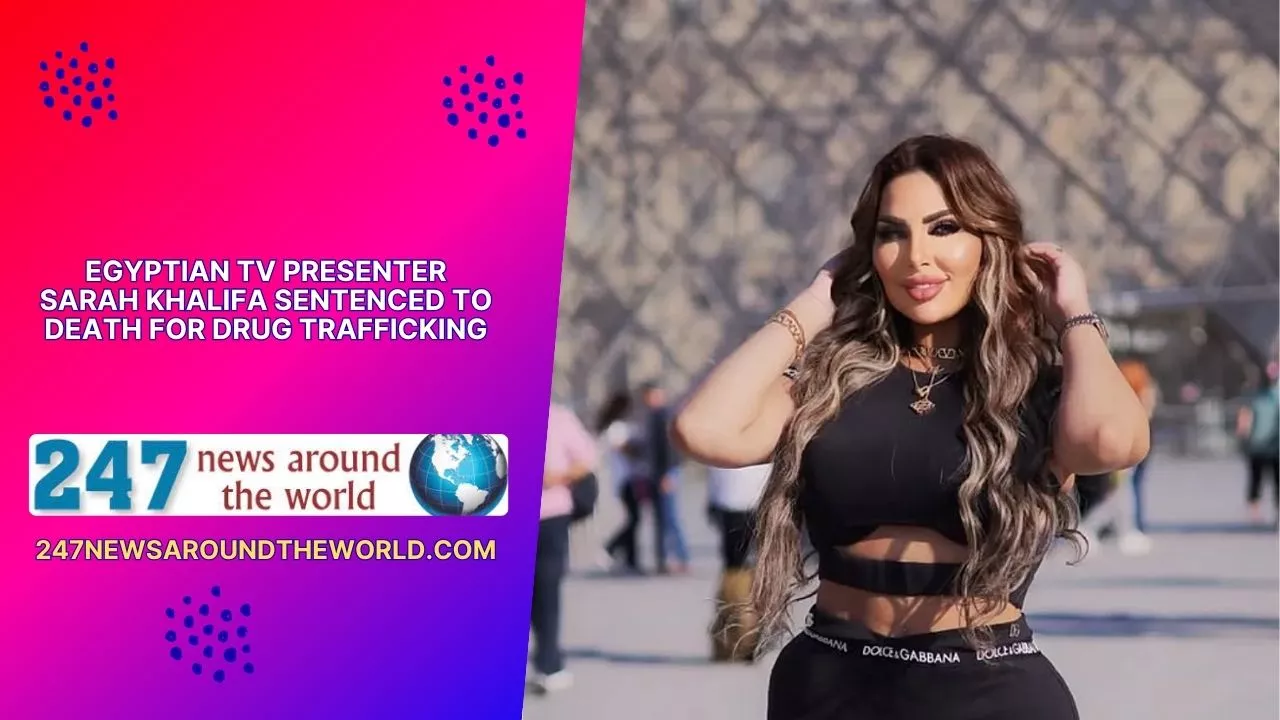

A criminal court in Cairo has sentenced Egyptian television presenter Sarah Khalifa and 11 other defendants to death by hanging after convicting them of forming an organized criminal gang that manufactured and trafficked narcotics. The verdict, reported by Egypt’s state-linked Al-Ahram newspaper on Saturday, September 6, 2026, involved a total of 28 defendants, more than 750 kilograms of seized drugs and raw materials, and the discovery of clandestine drug laboratories inside residential apartments.
Khalifa, 39, is best known for hosting “Mission Impossible,” a security and crime focused program that aired on private Egyptian channel Al-Mehwar TV. Beyond television, she ran a cosmetic surgery clinic and an event planning company and maintained a social media following of roughly 2.5 million on Instagram. Her lawyer has said she will appeal the sentence.
This article covers the details of the case, the charges, the court proceedings, who Sarah Khalifa is, the broader context of drug trafficking law in Egypt, and what is known about the appeals process that follows a capital sentence in the Egyptian legal system.

What Happened: The Court Verdict and Charges
The Cairo Criminal Court convicted Khalifa and 11 co-defendants on charges of forming an organized criminal gang that specialized in importing raw materials used to manufacture synthetic drugs, with the intent to traffic the finished product. The defendants were also convicted of possessing and carrying unlicensed firearms and ammunition.
الحكم بالإعدام بحق الإعلامية سارة خليفة في «قضية المخدرات الكبرى»، بعد اتهامها بقيادة تشكيل إجرامي يضم 28 شخصًا لتصنيع وترويج المخدرات داخل مصر.
وهذا الفيديو يوثق لحظتها بعد النطق بالحكم. https://t.co/ub0AKMHCYB pic.twitter.com/j9qNx19AkU
— قورجس (@gorgeous4ew) September 6, 2026
According to multiple outlets that cited the Al-Ahram report, the court sentenced all 12 to death by hanging and fined each defendant 500,000 Egyptian pounds (approximately $9,800). Nine additional defendants in the same case received life sentences, and seven others were acquitted. The case involved a total of 28 defendants.
Fact Box: Case Summary
| Detail | Information |
|---|---|
| Court | Cairo Criminal Court |
| Date of sentence | Saturday, September 6, 2026 |
| Total defendants | 28 |
| Sentenced to death | 12, including Sarah Khalifa |
| Sentenced to life imprisonment | 9 |
| Acquitted | 7 |
| Seized drugs and materials | Over 750 kilograms |
| Fine per defendant (death sentence) | 500,000 Egyptian pounds (~$9,800) |
| Khalifa’s age | 39 |
Evidence Presented in Court
The prosecution’s case rested on the seizure of more than 750 kilograms of narcotics and the raw materials used to produce them. Authorities reportedly discovered two apartments that were being used as clandestine laboratories for drug manufacturing. Al-Ahram reported that 20 witnesses provided testimony during the proceedings.
Who Is Sarah Khalifa: Career and Public Profile
Sarah Khalifa, 39, built her public profile across television, social media, and business. She is best known for hosting “Mission Impossible,” a program focused on security and crime stories that aired on Al-Mehwar TV, one of Egypt’s private satellite channels. She also co-hosted an entertainment program with popular Egyptian musician Hamo Bika.
Beyond television, Khalifa operated a cosmetic surgery clinic offering treatments including Botox, fillers, and plastic surgery procedures. She also ran an event planning company. Her Instagram account, which carried roughly 2.5 million followers at the time of her sentencing, was a significant part of her public presence, though her YouTube channel, with a far smaller following, had been inactive for over a year before her arrest.
Khalifa was briefly married in 2016 to former Egyptian football player Mahmoud Kharaba, who played for Zamalek SC, one of Egypt’s most prominent football clubs.
Sarah Khalifa’s Arrest and Investigation Timeline
Khalifa was arrested in April 2025 as part of the investigation into the drug trafficking network. Reports at the time of her arrest indicated that authorities detained her in a luxury apartment in Cairo where she allegedly played a role in coordinating drug deliveries. Investigators subsequently worked to identify and apprehend others connected to the operation, including both alleged accomplices and clients.
Timeline: Key Dates
| Date | Event |
|---|---|
| April 2025 | Sarah Khalifa arrested in Cairo on drug trafficking charges |
| 2025 to 2026 | Investigation and trial proceedings involving 28 defendants |
| September 6, 2026 | Cairo Criminal Court sentences Khalifa and 11 others to death by hanging |
| September 6, 2026 | In a separate case, Khalifa is sentenced to five years in prison for kidnapping and assault |
Sarah Khalifa’s Response to the Verdict
According to multiple reports, Khalifa reacted emotionally in court when the sentence was read. ABC News Australia reported that she declared in court that she had “never smoked a cigarette” in her life and swore she was innocent. Al Jazeera reported that she sobbed when the sentence was handed down.
Her lawyer has publicly stated that she will appeal the death sentence. Egypt’s legal system provides a mandatory appeals process for capital cases, and the sentence cannot be carried out until the appeal has been resolved.
The Separate Assault Case
In addition to the drug trafficking conviction, Khalifa and several co-defendants were sentenced to additional prison time in a separate case. France 24 reported that the same court sentenced her to five years in prison for the kidnapping and assault of a young man. Al Jazeera’s reporting described this as involving the assault and filming of her driver. The specific details of this second case have received less coverage than the drug trafficking charges.
Also Read: Reese Witherspoon Reveals Severe Post partum Depression After Birth of Daughter Ava
How Drug Trafficking Law Works in Egypt
Egypt maintains the death penalty for several categories of serious crime, including premeditated murder, certain terrorism offenses, some rape offenses, and drug trafficking. The legal framework for capital punishment in drug cases was strengthened in 2019, when Egypt’s cabinet approved a draft law mandating the death penalty for anyone who imports or exports synthetic substances with narcotic, anesthetic, or psychologically harmful effects.
A few key points about how capital sentences are handled in Egyptian law:
- Grand Mufti consultation: Egyptian law requires that before a death sentence is finalized, the court must obtain a religious opinion from Egypt’s Grand Mufti. This consultation occurred in Khalifa’s case before the sentence was publicly confirmed.
- Mandatory appeal: All death sentences in Egypt are subject to appeal through the Court of Cassation, Egypt’s highest court of criminal appeal. A sentence cannot be carried out until the appeals process is complete.
- Scale of capital sentencing: According to Amnesty International’s 2025 report, Egypt issued 492 death sentences in 2025, a 35 percent increase from 365 in 2024. The Egyptian Initiative for Personal Rights (EIPR) documented at least 461 death sentences handed down by criminal courts during 2025. Egypt executed 23 people in 2025, up from 13 the previous year.
- Drug-related death sentences: Of Egypt’s recorded death sentences in 2025, at least 12 were imposed for drug-related offenses, accounting for roughly 2 percent of the total. The vast majority of Egyptian death sentences are tied to cases involving premeditated murder or terrorism related charges.
Comparison Table: Egypt’s Death Penalty in Recent Years
| Year | Death Sentences Issued | Executions Carried Out | Key Source |
|---|---|---|---|
| 2024 | 365 | 13 | Amnesty International |
| 2025 | 492 | 23 | Amnesty International, EIPR |
These figures place Egypt among a small group of countries that still actively impose and carry out the death penalty. Amnesty International’s global count for 2025 recorded at least 2,707 executions worldwide, the highest number the organization has documented since 1981, though that figure excludes China, where death penalty data remains classified.
International Attention and Human Rights Context
Khalifa’s case has drawn international media coverage, reported by CNN, France 24, Al Jazeera, ABC News Australia, and i24 News, among others. The case’s high profile is partly driven by Khalifa’s public visibility as a TV host with millions of social media followers, which makes it more visible than the hundreds of other death sentences issued by Egyptian courts annually.
Human rights organizations have raised broader concerns about Egypt’s use of the death penalty, particularly around the volume of sentences and the fairness of trial proceedings. Amnesty International’s 2025 report noted that Egypt was among countries where death sentences were imposed after proceedings that did not meet international fair trial standards. Whether those specific concerns apply to Khalifa’s case has not been publicly addressed by the organizations in their reporting so far.
For readers following this story, the appeals process will be the next significant development. Until the Court of Cassation rules on the appeal, the death sentence remains subject to potential reversal or modification.
Why This Case Has Drawn Unusual Attention
Drug trafficking death sentences in Egypt are not rare in absolute numbers, but cases involving public figures of Khalifa’s profile are. Several factors have combined to make this case more visible than the hundreds of other capital sentences Egyptian courts issue each year:
- Celebrity status: Khalifa’s combination of a nationally broadcast TV show, millions of social media followers, and a cosmetic surgery business made her one of the most recognizable defendants to face a drug trafficking death sentence in recent Egyptian legal history.
- The irony of her TV program: The fact that Khalifa hosted a show called “Mission Impossible” that focused on security and crime stories has been widely noted in coverage of the case. The dissonance between her on-screen role discussing crime and the charges she now faces has amplified public interest.
- The scale of the operation: Over 750 kilograms of seized drugs and raw materials, two clandestine laboratories, and 28 total defendants make this one of the larger narcotics cases to reach a verdict in Egypt in recent years.
- International coverage: The case was reported by CNN, France 24, Al Jazeera, ABC News Australia, and i24 News, among others, giving it a reach well beyond Egyptian domestic media.
Egypt has seen other cases in which public figures were prosecuted on drug related charges, though convictions carrying the death penalty against individuals with Khalifa’s level of national visibility remain uncommon. This contributes to the degree of media attention the case has received both inside Egypt and internationally.
What Happens Next: The Egyptian Appeals Process
For readers unfamiliar with how capital cases move through the Egyptian legal system after sentencing, a few procedural points are worth understanding:
The Grand Mufti consultation that occurred in this case is a required step, not an optional one. Under Egyptian law, a court must submit a death sentence to the Grand Mufti for a religious opinion before the verdict can be publicly issued. The Mufti’s opinion is advisory rather than binding, but the consultation must take place as a legal formality.
After the sentence is publicly issued, the defense has the right to appeal to the Court of Cassation. This court reviews the case for legal errors, procedural violations, or constitutional concerns. If the appeal is accepted, the case may be retried or the sentence may be modified. If the appeal is rejected, the death sentence is upheld and can then be carried out.
In practice, the time between sentencing and a final resolution through the Court of Cassation can vary significantly, from months to years depending on the complexity of the case and the court’s schedule. During this period, the defendant remains in custody but the sentence is not carried out.
Khalifa’s lawyer has confirmed that an appeal will be filed, which means the case will continue to develop in the months ahead.
Frequently Asked Questions
Who is Sarah Khalifa?
Sarah Khalifa is a 39 year old Egyptian television presenter known for hosting the security and crime program “Mission Impossible” on Al-Mehwar TV. She also ran a cosmetic surgery clinic and had roughly 2.5 million Instagram followers.
What was Sarah Khalifa convicted of?
She was convicted of forming an organized criminal gang that imported materials used to manufacture synthetic drugs, with the intent to traffic them, and of possessing unlicensed firearms and ammunition.
How many people were sentenced to death in the case?
Twelve defendants, including Khalifa, were sentenced to death by hanging. Nine others received life sentences, and seven were acquitted.
Will Sarah Khalifa appeal the sentence?
Yes. Her lawyer has publicly stated that she will appeal. Egyptian law requires that all death sentences go through an appeals process before the Court of Cassation.
Does Egypt have the death penalty for drug trafficking?
Yes. Egypt maintains the death penalty for drug trafficking, as well as for premeditated murder, certain terrorism offenses, and some rape offenses. The legal framework was strengthened in 2019.
How many death sentences does Egypt issue annually?
According to Amnesty International, Egypt issued 492 death sentences in 2025 and executed 23 people that year.
Was Sarah Khalifa convicted in any other case?
Yes. In a separate case, she was sentenced to five years in prison for the kidnapping and assault of a young man.
Also Read: Iva Jovic Tennis Earnings, Career Rise, and Relationship Status Explained
Last Updated on September 7, 2026 by 247 News Around The World