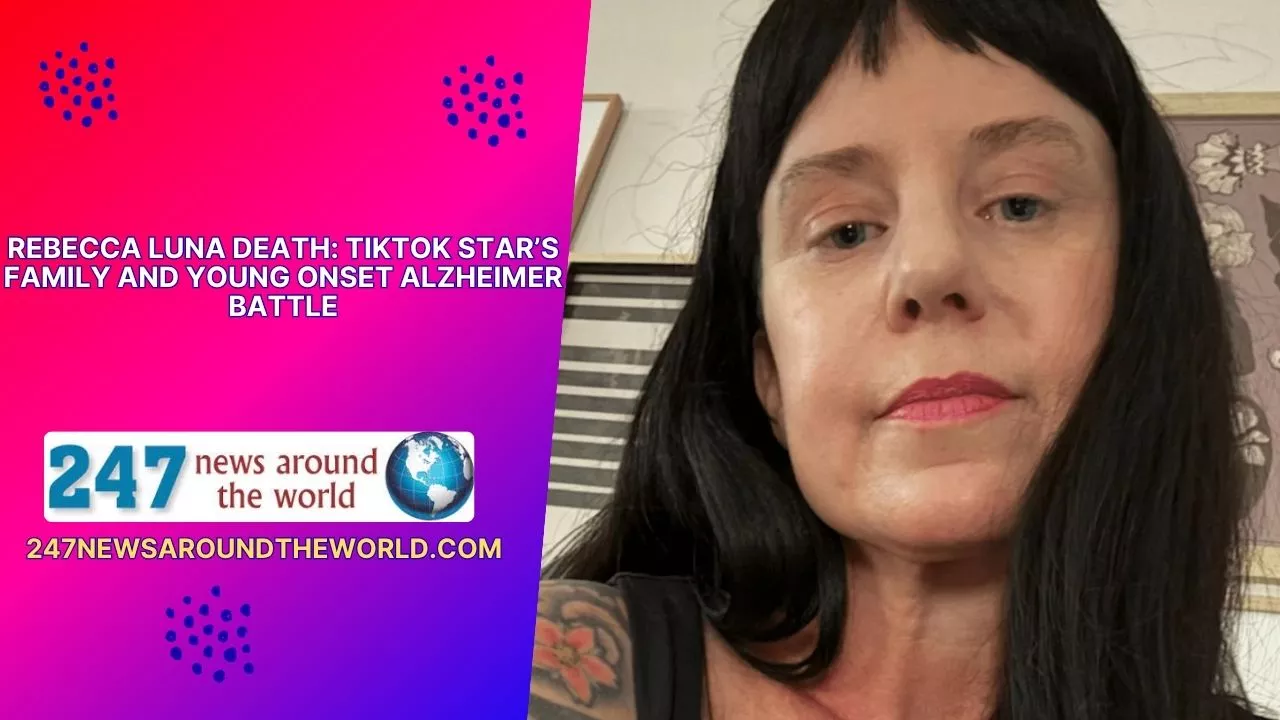

Rebecca Luna spent the last fifteen months of her life doing something most people avoid discussing at a dinner table, let alone on camera. She filmed her own cognitive decline and published it.
The Victoria, British Columbia creator died on Saturday, July 25, 2026, at the age of 49. A message posted to her TikTok account and to her fundraising page confirmed that she passed at approximately 1:15 p.m., surrounded by her loved ones, and asked her audience for support and privacy. She died through Medical Assistance in Dying, Canada’s legal assisted dying framework, after being diagnosed with young-onset Alzheimer’s disease at 48.
In the hours after the announcement, search traffic around her name surged. A large share of those searches asked about her family, her children, and whether she had a husband. This article answers those questions using what has actually been verified, corrects a piece of misinformation already circulating on low-quality obituary aggregator sites, and provides the context that most coverage skipped: why a woman with a progressive brain disease felt she had to die earlier than she wanted to.

FACT: What Is Confirmed
| Detail | Confirmed Information |
|---|---|
| Full public name | Rebecca Luna |
| Age at death | 49 |
| Date of death | Saturday, July 25, 2026 |
| Time reported | Approximately 1:15 p.m. local time |
| Location | Victoria, British Columbia, Canada |
| Cause | Medical Assistance in Dying (MAID), following young-onset Alzheimer’s disease |
| Diagnosis age | 48 |
| Public disclosure of diagnosis | April 2025 |
| Primary TikTok handle | @wheredidrebeccago |
| Confirmed by | Her eldest daughter, Maya, via her TikTok account and GoFundMe page |
| Children | Two adult daughters |
| Marital status | No verified husband. She publicly identified as a lifelong single mother. |
What Happened
The announcement of Rebecca Luna’s death arrived the same way most of her updates had: as a short post to the audience she had built from scratch.
The message was brief. It stated that Rebecca had passed away on July 25 at approximately 1:15 p.m., that she was surrounded by her loved ones, and it thanked followers for their support and asked for privacy. The same wording appeared as an update on the GoFundMe page she had created in June to cover her end-of-life expenses. Her eldest daughter, Maya, posted the update there, accompanied by an image of her own hand holding her mother’s.
Three days earlier, on July 22, Luna had told her followers that the date had changed. Her procedure had originally been scheduled for early August. She moved it to Saturday, July 25. In explaining the decision, she framed it as a matter of retaining control while she still could, saying her decline had arrived faster than she had hoped.
That single detail, the date being moved forward, is the most misunderstood part of this story. It is not a footnote. It is a direct consequence of how Canadian law is written, and we cover it in full below.
Rebecca Luna’s Family: What Is Actually Known
Did Rebecca Luna have a husband?
No verified evidence supports the existence of a husband, and Luna’s own public statements contradict the idea.
In the fundraising appeal she wrote herself, she described being a single mother her entire adult life, using the phrase “single mama” and adding that she was proud of it. Reporting from outlets including People, Complex, TMZ, and the Canadian broadcaster CHEK News has consistently described her as a single mother based in Victoria, British Columbia.
Several automatically generated “obituary” pages that appeared within twenty-four hours of her death describe her as a “beloved wife.” These pages contain no sourcing, no quotes from anyone who knew her, and no named author. They appear to be templated content produced at scale to capture grief-related search traffic. Readers should treat them as unreliable.
Her daughters
Luna was the mother of two adult daughters. Her eldest is publicly named Maya, who confirmed her mother’s death. The younger daughter’s name has not been widely published, and the family has explicitly asked for privacy.
This detail carries more weight than it may first appear. When Luna set up her fundraiser, she stated that her motivation was to avoid leaving her children with the financial burden of her death on top of their grief. Her stated reason for the campaign was end-of-life expenses. Earlier reporting from 2025 indicated she had also hoped to create a fund for her two adult children and to complete items on a bucket list.
Following her death, her daughters asked supporters to honour her by living fully and treating others with kindness.
Her life before TikTok
Luna was not a professional influencer. In interviews and posts covered by Canadian and international outlets, she was described as having worked in child protection services, a career built around safeguarding vulnerable young people.
That background matters when you evaluate the tone of her content. She approached her own diagnosis with the vocabulary of someone used to case files, assessments, and systems: cognitive testing, MRI results, medial temporal atrophy scoring, eligibility criteria. Luna was not performing vulnerability. She was documenting a process.
Timeline: From First Symptoms to Final Post
Before 2025: The years of not knowing Luna experienced memory lapses, difficulty with spatial awareness, and other subtle changes. She initially attributed them to her mental health history and underwent cognitive testing with a psychiatrist. She did not pass those tests.
Diagnosis at 48 A neurologist conducted further cognitive testing and reviewed her MRI scans and medial temporal atrophy score, leading to a diagnosis of young-onset Alzheimer’s disease. She has described a long stretch of testing and personal denial preceding this point.
April 2025: Going public On a spur-of-the-moment decision, she posted a video disclosing her diagnosis. It reached more than two million views. Her account, @wheredidrebeccago, began growing rapidly.
Mid-2025: Building a virtual support group Luna began posting regular updates covering doctor’s appointments, symptom progression, and daily coping strategies. Canadian outlet CHEK News profiled her in the summer of 2025, noting that she was using social media to build what amounted to a virtual support group for others with the same diagnosis.
2025 into 2026: MAID advocacy She began the application process for Medical Assistance in Dying and started answering follower questions about eligibility, assessment, and the legal framework. She described herself in her bio as a young-onset Alzheimer’s and MAID advocate.
The Lily Allen moment Luna revealed that meeting the British singer Lily Allen was on her bucket list. The post reached Allen, who invited her to a concert. Luna described it afterward as the best experience, and one of the happiest moments of her life.
June 2026: The fundraiser She launched a GoFundMe for end-of-life expenses, writing that followers had suggested it and that she did not want to leave her family carrying the cost alongside their grief.
July 22, 2026: The date moves Luna announced that her MAID date had been brought forward from early August to Saturday, July 25.
July 25, 2026: Her death She died at approximately 1:15 p.m., surrounded by loved ones.
Understanding Young-Onset Alzheimer’s Disease
Young-onset Alzheimer’s, also called early-onset Alzheimer’s, refers to cases diagnosed before the age of 65. Commonly cited estimates place it at roughly five to ten percent of all Alzheimer’s diagnoses. Many of those diagnosed are in their forties and fifties.
The clinical picture is not simply “Alzheimer’s, but earlier.” The practical differences are significant.
| Factor | Typical late-onset Alzheimer’s | Young-onset Alzheimer’s |
|---|---|---|
| Age at diagnosis | 65 and older | Under 65, often 40s and 50s |
| Time to diagnosis | Symptoms are often recognised sooner | Frequently misattributed to stress, depression, burnout, or perimenopause |
| First symptoms | Memory loss most common | More likely to involve language, vision, spatial awareness, or executive function |
| Employment impact | Usually already retired | Often still working, sometimes as primary earner |
| Family stage | Adult children, often grandchildren | May still have dependent children or young adults at home |
| Support services | Widely designed for this group | Age-inappropriate; most day programs are geared to seniors |
Luna’s own account touched nearly every point in that right-hand column. She described initially believing her symptoms were connected to mental health. Luna noted that Alzheimer’s spans multiple symptom categories and that she had met all of them. She was raising a family and working in a demanding profession.
Also Read | Meet Emma Roberts Famous Family: Parents, Aunt Julia Roberts, and Siblings
Why the Date Was Moved Up: The Legal Detail Most Coverage Missed
This is where the story becomes something larger than one creator’s death.
Medical Assistance in Dying has been legal in Canada since 2016 under Bill C-14, with the framework substantially amended in 2021 under Bill C-7. Under the current law, a person must generally have the capacity to consent at the moment the procedure is provided. There are narrow exceptions, but the baseline principle holds.
For a person with a progressive dementia, that requirement creates a cruel arithmetic. Losing cognitive capacity is the disease. If you wait until your suffering becomes unbearable, you may have already lost the legal ability to consent, and with it, your eligibility.
The two exceptions available in Canada are narrower than most readers assume:
- Waiver of final consent. This is a written arrangement available only to people on what the law calls Track 1, meaning those whose natural death is reasonably foreseeable. It requires that the person already be assessed, approved, and have a date set, and that all eligibility criteria be met before capacity is lost. It is not available on Track 2.
- Advance requests. These allow a person diagnosed with a serious and incurable illness to request MAID for a future point when they can no longer consent. As of this writing, advance requests are permitted only in Quebec, which became the first Canadian province to allow them on October 30, 2024. They are not available in British Columbia, where Luna lived.
The Alzheimer Society of Canada states plainly that advance requests are not permitted under Canadian law outside Quebec.
This is the structural reason people with dementia across most of Canada face pressure to choose an earlier date than they would otherwise want. The Canadian children’s author Robert Munsch, who has dementia, summarised the same dilemma bluntly in comments to The New York Times, describing the need to pick a moment while he could still ask.
Luna’s decision to move her procedure from August to July, framed publicly as taking control of her own life, sits squarely inside that legal reality.
The Numbers Behind the Debate
Health Canada’s sixth annual report on Medical Assistance in Dying, covering 2024, recorded 16,499 MAID deaths. That represented 5.1 percent of all deaths in Canada, or slightly more than one in twenty. Year-over-year growth was 6.9 percent, a marked slowdown from growth rates above thirty percent in earlier years.
The same report showed that 95.6 percent of provisions were Track 1 cases, where natural death was reasonably foreseeable, with 4.4 percent on Track 2. British Columbia, Luna’s province, recorded 2,997 MAID deaths in 2024. More than four thousand people who applied died of other causes before their request could be fulfilled.
Dementia-related cases remain a small share of the total. Analyses of Ontario coroner death review data reported roughly one hundred dementia-related provisions across a recent two-year window, with Alzheimer’s disease the most common single dementia diagnosis among them.
These figures matter because they cut against the two loudest narratives online. MAID for dementia is neither the routine, casual process critics describe, nor the freely available option that supporters sometimes imply. It is legally narrow, and for people with progressive cognitive disease it is time-limited by design.
Why It Matters
Three reasons this story extends beyond one creator’s account.
It made an invisible disease visible. Alzheimer’s under 65 is routinely misdiagnosed, dismissed, or explained away as stress. Luna’s first video reached over two million people. Some of them recognised their own symptoms in hers.
It exposed a legal gap in real time. Most public discussion of assisted dying happens in the abstract, through op-eds and parliamentary committees. Luna documented what the capacity requirement means in practice for a specific person with a specific diagnosis, in a province without advance requests.
It tested what social platforms are for. TikTok is optimised for entertainment. Luna used it as a public health archive, a support group, and eventually a record of her own ending. That is not what the algorithm was built to reward, and it worked anyway.
Social Media and Public Reaction
The response fell into recognisable groups.
Her own community. Followers with dementia diagnoses, and caregivers of people with them, described her account as the first place they had seen the disease discussed by someone their own age. Many said her videos helped them understand what they were facing.
Broad public sympathy. Coverage across People, TMZ, Complex, the Mirror, LADbible, and Canadian outlets drove her story well outside her follower base within twenty-four hours.
Ethical disagreement. Assisted dying remains contested in Canada and internationally. Disability rights organisations have raised concerns about whether adequate support exists before people reach the point of requesting MAID. Faith-based and pro-life groups have criticised the expansion of the framework. Supporters, including organisations like Dying With Dignity Canada, argue that autonomy at the end of life is a matter of basic dignity. Luna’s comment sections carried all of these positions.
Misinformation. Within a day, templated obituary pages appeared with fabricated biographical framing, including the “wife” claim addressed earlier in this article.
One reported detail worth noting for accuracy: follower counts published for her account vary considerably between outlets, ranging from around 47,000 in some reports to more than 90,000 in others, with at least one outlet citing a far higher figure. Follower numbers on a rapidly circulating account shift by the hour, and no single figure should be treated as authoritative.
Career and Financial Impact
Luna was not monetising grief. Her situation reflects a specific and growing pattern.
The fundraiser. She launched a GoFundMe in June 2026 for end-of-life expenses. Reports from July 26 placed the total raised at around CAD 9,770, a figure that will have changed since publication. Her stated purpose was to prevent her daughters from inheriting funeral and end-of-life costs.
The economics of a terminal diagnosis. Canada’s public healthcare system covers medical treatment, but a diagnosis at 48 typically ends a career at peak earning years, wipes out future contributions to retirement savings, and creates costs that healthcare does not cover: funeral arrangements, legal work, home modifications, lost income for family caregivers. Luna had worked in child protection services, a public-sector career, not one that generates the kind of savings buffer that a decade of lost earnings requires.
The creator economy angle. Luna’s audience grew because of her illness. That creates an uncomfortable dynamic that she appears to have handled deliberately by pointing the attention toward advocacy and information rather than brand deals. Her bio positioned her as an advocate rather than an influencer.
Historical Comparison: Voices That Changed the Conversation
| Person | Year | Condition | Jurisdiction | Legacy |
|---|---|---|---|---|
| Brittany Maynard | 2014 | Terminal brain cancer, age 29 | Relocated from California to Oregon | Her public advocacy contributed directly to California passing its End of Life Option Act in 2015 |
| Audrey Parker | 2018 | Terminal cancer, Nova Scotia | Canada | Died earlier than she wished to preserve capacity; her campaign led to the 2021 waiver of final consent provision, informally called Audrey’s Amendment |
| Sandra Demontigny | 2024 onward | Young-onset Alzheimer’s | Quebec | Central figure in Quebec’s move to permit advance requests |
| Robert Munsch | 2025 | Dementia, age 80 | Ontario | Publicly described the dilemma of choosing a moment while still able to ask |
| Rebecca Luna | 2026 | Young-onset Alzheimer’s, age 49 | British Columbia | Documented the daily lived experience and the legal timing pressure to a mass social audience |
The pattern is consistent across a decade. Legal change in this area has been driven repeatedly by individuals who chose to make private decisions public. Audrey Parker’s case is the closest structural parallel to Luna’s: a person compelled to die sooner than she wanted because waiting risked losing eligibility.
Interesting Facts You May Not Have Read Elsewhere
- Her handle, @wheredidrebeccago, functions as a description of the disease itself, framed with the dark humour that ran through much of her content. Some outlets have reported a variant handle, so readers may encounter more than one spelling.
- Her first disclosure video reached over two million views, a scale most creators never reach after years of posting.
- She sought cognitive testing initially through a psychiatrist, believing her symptoms were psychological, before a neurologist reached the Alzheimer’s diagnosis.
- She used specific clinical terminology publicly, including her medial temporal atrophy score, an MRI-based measure of brain tissue loss rarely discussed outside neurology settings.
- She was told she could apply for MAID and decide later whether to proceed, a detail she shared to correct the assumption that applying and proceeding are the same act.
- Her tags frequently included perimenopause health, reflecting how often women’s early cognitive symptoms are attributed to hormonal changes rather than investigated neurologically.
What Comes Next: Reasonable Expectations
Her account becomes an archive. Creator accounts documenting terminal illness typically remain online after death, managed by family. Expect her videos to continue circulating and to keep reaching newly diagnosed people.
The advance request debate intensifies. Quebec’s framework has approved more than two thousand advance requests since October 2024. Every high-profile case in a province without them, including this one, adds pressure toward either federal amendment or a constitutional challenge. Health Canada has already published work on advance requests, and the Alzheimer Society of Canada has responded formally to it.
Scrutiny of AI-generated obituary content grows. The speed at which fabricated tribute pages appeared here is a live search-quality problem, and one that platforms and search engines are under increasing pressure to address.
Young-onset awareness improves slowly. A single account does not fix diagnostic delay. But the volume of comments from viewers recognising their own symptoms suggests measurable downstream effect.
Frequently Asked Questions
How did Rebecca Luna die?
She died through Medical Assistance in Dying, Canada’s legal assisted dying framework, on July 25, 2026, following a young-onset Alzheimer’s diagnosis. Her family stated she died at approximately 1:15 p.m., surrounded by loved ones.
How old was Rebecca Luna?
She was 49. She had been diagnosed at 48 and publicly disclosed her diagnosis in April 2025.
Was Rebecca Luna married? Did she have a husband?
There is no verified evidence of a husband. She publicly described herself as having been a single mother her entire adult life. Pages describing her as a “wife” appear to be automatically generated and unreliable.
Did Rebecca Luna have children?
Yes, two adult daughters. Her eldest, Maya, confirmed her death publicly. The family has asked for privacy.
Where did Rebecca Luna live?
Victoria, British Columbia, Canada.
What was Rebecca Luna’s TikTok account?
Her primary handle was @wheredidrebeccago. Reported follower counts vary widely across outlets.
Why did she move her death date earlier?
She stated the change reflected her wish to retain control as her decline accelerated. Under Canadian law outside Quebec, a person with dementia must retain the capacity to consent, which means waiting too long can mean losing eligibility entirely.
Is MAID the same as suicide?
Legally and clinically they are treated as distinct. MAID is a regulated medical procedure requiring assessment by two independent practitioners, a documented grievous and irremediable condition, and demonstrated decision-making capacity. Advocacy organisations describe it as an end-of-life healthcare option for a mentally capable, terminally ill adult.
Is MAID legal everywhere in Canada?
MAID is legal nationwide, but advance requests, which allow a person to arrange MAID for a future point after capacity is lost, are currently permitted only in Quebec, since October 30, 2024.
How many people use MAID in Canada?
Health Canada’s sixth annual report recorded 16,499 MAID deaths in 2024, representing 5.1 percent of all deaths in Canada that year.
What is young-onset Alzheimer’s?
Alzheimer’s disease diagnosed before age 65. It represents an estimated five to ten percent of cases and is frequently misattributed to stress, depression, or hormonal changes before a correct diagnosis is reached.
How can I verify claims about her life?
Prioritise outlets that name their reporters and cite their sourcing, including People, CHEK News, and major wire-sourced coverage. Treat unsourced obituary aggregator pages as unreliable
Also Read | Kim Kardashian Pays Heartfelt Tribute to Late Grandma MJ on First Posthumous Birthday
Last Updated on July 27, 2026 by 247 News Around The World