
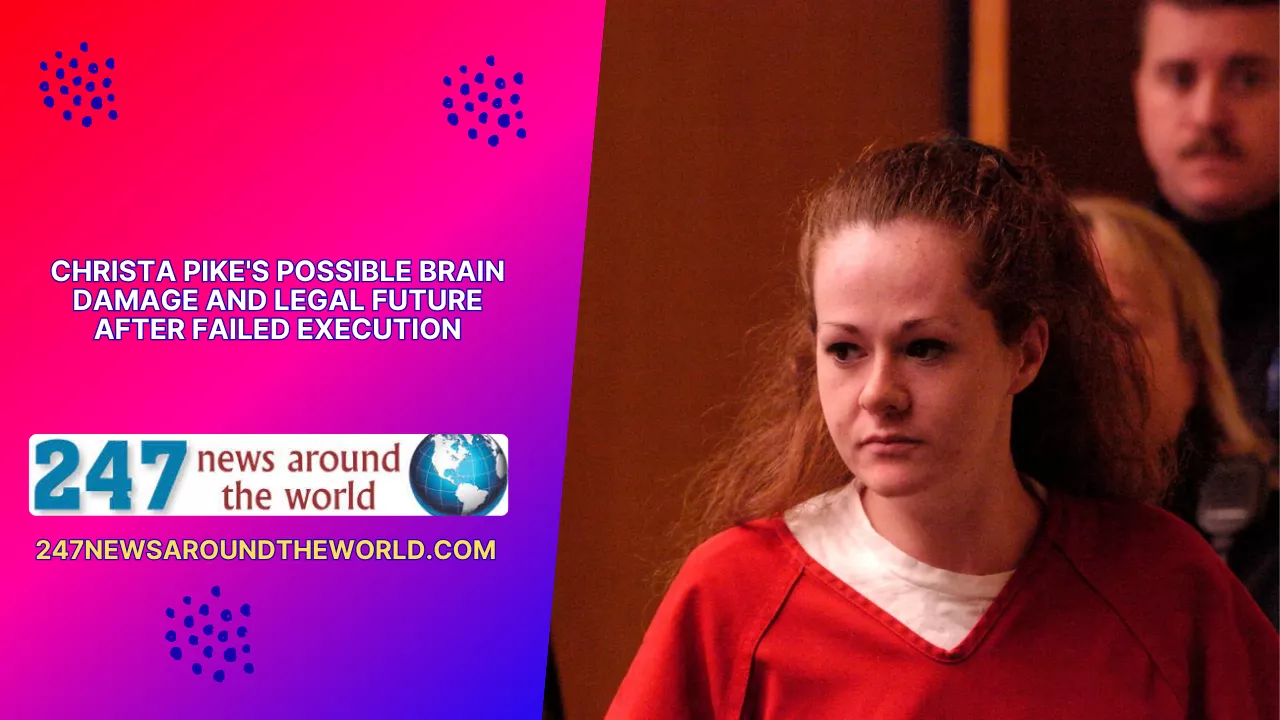

At some point on Wednesday night, September 30, 2026, inside the execution chamber at Riverbend Maximum Security Institution in Nashville, something happened that American capital punishment has almost no modern precedent for.
Tennessee administered two doses of pentobarbital to Christa Gail Pike. She did not die. Witnesses reported she remained alive and audibly snoring. Her attorneys told a federal court she had not lost consciousness and still had a heartbeat.
Nearly two hours after the protocol began, the execution was called off. Ambulances arrived at the prison. Pike, 50, was transported to an off-site medical facility, where she remains.
As of Thursday afternoon, October 1, her attorneys said she was alive and in critical condition. They also said they had not been told her prognosis.
One question now sits at the center of everything that follows: whether Christa Pike sustained brain damage during the failed attempt, and what that would mean for a death sentence that the state has already tried once to carry out.
This article sets out what is actually known, what remains speculation, and the legal questions the case now raises. Given how fast this is moving, readers should check current reporting for developments after publication.
Also Read: Terrance Banks Case Timeline: Prior Arson Threat Before the 15-Dog Geneva Fire
The Brain Damage Question: What Has Actually Been Said
The source of the brain injury concern is Dr. Joel Zivot, a professor at Emory University School of Medicine and an anesthesiologist who has joined Pike’s legal team.
Speaking to the BBC, Zivot said it is possible Pike could be left with brain damage as a result of the failed execution.
“It’s very possible,” he said, “that as a consequence of the delay of the beginning of resuscitation she will have a brain injury.”
Several things need stating plainly about that quote.
It is a clinical possibility raised by a physician, not a diagnosis. No medical assessment of Pike’s neurological status has been made public. Her own attorneys said they had not been informed of her condition beyond knowing she was alive and receiving lifesaving care.
Zivot is also a member of her legal team, not a neutral observer. That does not make his medical expertise less real, but readers should weigh it accordingly.
The mechanism he describes is straightforward in principle. Pentobarbital in lethal doses suppresses breathing. If a person stops breathing adequately but is not resuscitated promptly, the brain is deprived of oxygen. Hypoxic brain injury can follow, and its severity depends heavily on how long the deprivation lasts. The gap Zivot points to is the delay between the drugs taking effect and the start of medical intervention.
Whether that occurred in Pike’s case, and to what degree, is currently unknown.
What Is Known Versus Unknown
| Question | Status |
|---|---|
| Is Pike alive? | Yes, confirmed by her attorneys as of October 1 |
| What is her condition? | Critical, per her attorneys |
| Has brain damage been confirmed? | No. Raised as a possibility by a physician on her legal team |
| What is her prognosis? | Unknown. Attorneys say they have not been told |
| Which hospital is she in? | Not disclosed in state filings |
An Important Distinction: Congenital Versus Acquired Brain Injury
There is a detail here that is easy to conflate and important to keep separate.
Christa Pike’s legal filings have asserted for years that she was born with brain damage, possibly linked to her mother’s alcohol use during pregnancy. That congenital condition formed part of the mitigation case her attorneys argued should have been presented at her 1996 trial, alongside her documented history of childhood sexual abuse, neglect, PTSD and bipolar disorder.
That is a pre-existing claim, decades old, and separate from anything that may have happened on September 30.
The brain injury Dr. Zivot raised is a potential new, acquired injury caused by the execution attempt itself.
The two are not the same thing, and coverage that blurs them produces confusion. If Pike has sustained a hypoxic injury this week, it would be an additional condition layered on top of circumstances her lawyers have been litigating for nearly thirty years.
What Happened Inside the Chamber on September 30
The execution had been scheduled for 10 a.m. Central. It did not begin then.
Christa Pike likely has ‘brain injury’ after botched execution – here’s what went wrong: ‘Degraded’ drugs, damaged veins https://t.co/NpPBsQCDdP pic.twitter.com/fb4vJDYKjQ
— New York Post (@nypost) October 1, 2026
The day was consumed by legal manoeuvring. A three-judge panel of the Sixth Circuit Court of Appeals temporarily stayed the execution, after the US District Court for the Eastern District of Tennessee determined it lacked jurisdiction over a Rule 60(b)(6) motion Pike had filed seeking to reopen a denial of habeas relief.
The United States Supreme Court vacated that stay on Wednesday evening, roughly an hour before the midnight deadline on the death warrant would have expired. The execution could proceed.
Two doses of pentobarbital were administered. Pike continued breathing.
Her defence lawyers filed an emergency federal motion during the process, citing witness accounts that executioners had injected both syringes and that Pike was still alive and snoring. They sought to halt the execution and obtain medical care for her.
The attempt was stopped. Emergency vehicles arrived at the prison.
In a statement issued more than two hours later, Tennessee Department of Correction Communications Director Dorinda Carter said the department “followed every step of the State’s lawful, established execution protocol approved by the Attorney General’s Office,” and confirmed Pike had been transported to an off-site medical facility.
Attorney General Jonathan Skrmetti’s office filed a supplemental court document stating she was receiving medical care. Neither her condition nor the hospital was identified.
“Christa is alive right now,” attorney Randy Spivey of the Tennessee Office of the Post-Conviction Defender said at a press conference the following day. “We don’t have a sense of her prognosis or much update on her health at the moment, but we do know that she is alive right now and receiving lifesaving medical care.”
Tennessee Halts Executions and Orders an Independent Review
Governor Bill Lee, who had denied Pike clemency two days earlier, responded by suspending the rest of the state’s execution schedule.
Lee cancelled Tennessee’s remaining 2026 execution, that of Gary Wayne Sutton, which had been set for December 3, and ordered a comprehensive third-party review of what went wrong.
He described himself as “highly disappointed,” saying Tennesseans expect a lawfully imposed death sentence to be carried out “in a manner that’s not only legal and constitutional, but effective,” and acknowledging that the attempted execution did not happen as expected.
This is not the first time Lee has paused Tennessee executions. He halted them in 2022 after an investigation found prison officials were not following the state’s own lethal injection rules. Executions resumed in 2026 under a revised protocol.
It is also not the state’s first failure this year. In May 2026, the execution of Tony Carruthers was halted after officials spent roughly an hour unable to establish IV access. Lee granted him a one-year stay. That makes two failed executions in five months under the new protocol.
A death penalty expert quoted by the Associated Press described what happened to Pike as an unprecedented failure.
Timeline of Events
| Date | Development |
|---|---|
| May 2026 | Tony Carruthers execution halted after officials cannot find a vein; Lee grants a one-year stay |
| Sept 12, 2026 | Tennessee Supreme Court declines to hear Pike’s latest challenge |
| Sept 28, 2026 | Governor Lee denies clemency |
| Sept 30, morning | Execution scheduled for 10 a.m. Central; legal filings delay it |
| Sept 30, evening | Sixth Circuit stays the execution; US Supreme Court vacates the stay |
| Sept 30, night | Two doses of pentobarbital administered; Pike remains alive |
| Sept 30, approx. 2 hours in | Execution halted; Pike transported to hospital by ambulance |
| Oct 1 | Attorneys confirm she is alive and in critical condition; prognosis unknown |
| Oct 1 | Lee cancels remaining 2026 execution and orders independent review |
Can Tennessee Legally Try Again
This is the question that has no comfortable answer, and it is worth being precise rather than speculative.
The controlling precedent is old. In Louisiana ex rel. Francis v. Resweber, decided in 1947, the Supreme Court considered the case of Willie Francis, a teenager who survived a failed electrocution in Louisiana. By a 5 to 4 vote, the Court held that a second attempt did not violate the Eighth Amendment’s prohibition on cruel and unusual punishment, reasoning that the failure was an unforeseeable accident rather than deliberate cruelty. Francis was executed the following year.
Resweber has never been overturned. On its face, it suggests a state may try again.
But nearly eighty years have passed, and Eighth Amendment jurisprudence has developed considerably. Courts now apply an evolving standards of decency analysis. Whether a 1947 decision about an electric chair malfunction governs a 2026 case involving two full doses of a lethal drug, a two-hour ordeal and a surviving prisoner in critical condition is genuinely untested.
Pike’s legal team had already argued before September 30 that Tennessee’s single-drug pentobarbital protocol carried a serious risk of severe pain, and that a blood condition she has would produce unusually severe pulmonary edema. She had sought the firing squad as an alternative. Those arguments will now be made against the backdrop of a documented failure.
The competency question
If Pike did sustain significant brain injury, a separate line of constitutional law becomes relevant.
Under Ford v. Wainwright, decided in 1986, the Eighth Amendment prohibits executing a prisoner who is ins@ne. Panetti v. Quarterman, decided in 2007, refined the standard, requiring that a prisoner have a rational understanding of the reason for their execution. Atkins v. Virginia, decided in 2002, separately bars the execution of people with intellectual disability.
A severe acquired brain injury could, in principle, trigger a competency challenge under this line of cases. Whether it would succeed depends entirely on medical findings that do not yet exist.
There is a grim circularity here that courts would have to confront: the state’s own failed attempt to carry out a sentence may have produced the condition that prevents the sentence being carried out.
The Victim’s Family and What They Are Living Through
Any account of this case that focuses only on Pike is incomplete.
Colleen Slemmer was 19 years old when she was tortured and killed in Knoxville in January 1995. Her mother, May Martinez, has spent more than thirty years waiting for the sentence to be carried out, and she travelled to Riverbend on Wednesday expecting it to happen.
Instead she sat through a day of stays and reversals, was seen walking out of the prison during one of the pauses, and ended the night with the sentence not carried out and her daughter’s killer in a hospital.
Reporting on the family’s reaction has carried a consistent message from them: think about Colleen.
Whatever position a reader holds on capital punishment, the failure of September 30 inflicted something on this family as well. A process that was supposed to provide finality instead produced another indefinite wait.
What Happens Next
Several threads are now open at once, and none has a clear timeline.
Pike’s medical condition is the immediate unknown. Until her prognosis is established, nothing else can be meaningfully assessed. Her attorneys have said they will share information as they receive it.
The governor’s independent review will examine what went wrong with the protocol. Its findings may affect not only Pike’s case but the future of lethal injection in Tennessee generally, given this is the second failure in five months.
Litigation is certain. Pike’s legal team had active challenges before Wednesday, and the failed attempt gives them substantial new material. The state has said it followed its approved protocol, which sets up a direct factual dispute about whether a protocol that was followed correctly can still produce this outcome.
International attention has intensified. Amnesty International issued a statement on her hospitalisation, and before the attempt, Morris Tidball-Binz, the UN special rapporteur on arbitrary executions, had warned the Times that executing Pike would amount to torture.
No new execution date can realistically be set while the review is ongoing and her condition is unresolved.
Frequently Asked Questions
Does Christa Pike have brain damage after the failed execution?
It has not been confirmed. Dr. Joel Zivot, an Emory University School of Medicine professor and anesthesiologist who has joined her legal team, told the BBC it is “very possible” she sustained a brain injury due to the delay before resuscitation began. No medical assessment of her neurological condition has been made public, and her attorneys say they have not been told her prognosis.
Is Christa Pike still alive?
Yes. Her attorneys confirmed at a press conference on Thursday, October 1, 2026, that she was alive and in critical condition, receiving lifesaving medical care at an undisclosed hospital.
What went wrong with the execution?
Tennessee administered two doses of pentobarbital. Witnesses and her attorneys reported that Pike remained alive, had not lost consciousness, retained a heartbeat and was audibly snoring. The attempt was halted roughly two hours after it began. The Department of Correction said it followed every step of the state’s approved protocol.
Can Tennessee execute Christa Pike again?
Legally, there is precedent suggesting a second attempt is permitted. In Louisiana ex rel. Francis v. Resweber, 1947, the Supreme Court allowed a second execution attempt after a failed electrocution. That ruling has never been overturned, but Eighth Amendment law has evolved considerably since, and the question has not been tested on facts like these. If Pike sustained severe brain injury, competency rulings including Ford v. Wainwright and Panetti v. Quarterman could also apply.
Has Tennessee paused executions?
Yes. Governor Bill Lee cancelled the state’s remaining 2026 execution, scheduled for December 3, and ordered a comprehensive third-party review of the failed attempt. He said he was “highly disappointed” with what happened.
Has this happened in Tennessee before?
Yes, recently. In May 2026, the execution of Tony Carruthers was halted after officials were unable to establish IV access for about an hour. Lee granted him a one-year stay. Pike’s is the state’s second failed execution in five months under its revised protocol.
Who was Colleen Slemmer?
Colleen Slemmer was a 19-year-old student at the Knoxville Job Corps who was tortured and killed in January 1995. Pike, then 18, was convicted of her murder in 1996 and sentenced to death. Slemmer’s mother, May Martinez, has supported the execution and was present at the prison on September 30.
Also Read: Simone Biles Skin Condition Diagnosis and Her Long Battle With Eczema
Last Updated on October 2, 2026 by 247 News Around The World